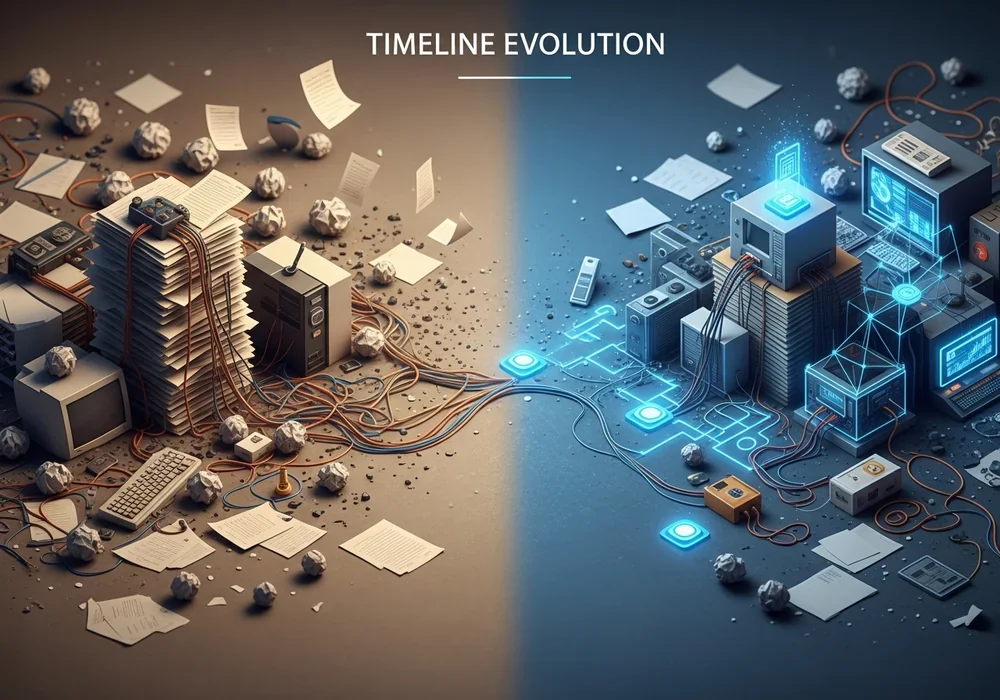
The Evolution: From 2024’s Cleanup to 2026’s AI Agents

Do you remember the panic of March 2024? That was just the beginning. To truly understand the 2026 Google SEO algorithm changes, we have to look at the trajectory of the last two years. It wasn’t just about penalizing spam; it was about reshaping the web for a new type of user.
In 2024, Google focused heavily on the Helpful Content Update (HCU), effectively wiping out mass-produced, low-value AI content. By 2025, the focus shifted to “Hidden Gems” and forum discussions, prioritizing Reddit and Quora to find human voices amidst the synthetic noise. Now, in 2026, we are facing the era of the “AI Agent.” Search engines are no longer just retrieving links; they are synthesizing answers.
Here is a quick breakdown of the major shifts you need to know:
| Year | Primary Focus | The “Death” Of |
|---|---|---|
| 2024 | Helpful Content & Spam Removal | Programmatic SEO (Mass Gen) |
| 2025 | Visual Search & Human Experience | Generic Product Reviews |
| 2026 | Information Gain & Agent Optimization | Skyscraper Technique (Rewriting) |
If you are still using 2024 tactics like simply making your content “longer” than the competition, you are likely seeing diminishing returns. The current algorithm is smarter and far more demanding.
The New Ranking Factor: Information Gain Scores
This is arguably the most critical part of the 2026 Google SEO algorithm changes. Google has patented and fully rolled out systems that measure “Information Gain.” But what does this actually mean for you as a junior SEO specialist?
Simply putting it, if your article repeats the same points as the top 10 search results, your Information Gain score is zero. You won’t rank, even if your domain authority is high. The algorithm is now hunting for additive value. This could be original data, a unique counter-argument, or a personal case study that contradicts popular belief.
To improve your score, try these actionable tips:
- Conduct Original Surveys: Even a poll of 50 people provides unique data points that AI cannot hallucinate.
- Expert Quotes: Don’t just paraphrase; interview a subject matter expert.
- Contrarian Angles: If everyone says “do X,” explain why “doing Y” might work better in specific scenarios.
You can also check https://namuseo.com for more information on structuring data for better crawlability, which supports this gain scoring.
Technical SEO: Optimizing for Machines, Not Just Humans
We used to talk about Core Web Vitals strictly for human user experience. However, the 2026 Google SEO algorithm changes have introduced a new layer: Agent readability. AI search agents need to parse your site structure faster than ever to generate real-time answers.
If your JavaScript rendering is slow, the AI agent skips you. It doesn’t have the patience of a human. We are seeing a massive shift towards server-side rendering (SSR) and ultra-clean schema markup. It’s not just about Article schema anymore; it’s about nesting FAQ, HowTo, and Profile schemas to give the bots a structured map of your content.
Pro Tip: Check your “Crawl Stats” in Search Console. If the time spent downloading a page has increased, you are in the danger zone. Efficient code is now a ranking signal because it reduces the computational cost for Google.
E-E-A-T in 2026: Why Personal Narrative Wins
You might think AI has taken over, but paradoxically, the 2026 Google SEO algorithm changes value human authenticity more than ever. The “Experience” in E-E-A-T (Experience, Expertise, Authoritativeness, Trustworthiness) is the tie-breaker.
Why? Because AI can fake expertise, but it cannot fake experience. It hasn’t unboxed the product. It hasn’t felt the texture of the fabric. It hasn’t dealt with the customer service of the software company.
Here is how you inject “Experience” into your content:
- Use First-Person Narratives: “I found that…” or “In my testing…”
- Visual Proof: Include original photos (not stock images) of you using the product or service. Google’s vision AI can distinguish between stock and real photos.
- Admit Failures: AI rarely talks about what went wrong. Describing a mistake you made adds a layer of trust that algorithms love.
If you ignore the human element, you are essentially competing directly with Google’s own AI, and that is a battle you will not win.
Conclusion: Adapt or Fade Away
The 2026 Google SEO algorithm changes are not about punishing website owners; they are about filtering out the noise. The internet became too cluttered with generic content, and Google had to evolve.
To succeed this year, focus on Information Gain, tighten your technical infrastructure for AI agents, and double down on authentic human experience. Don’t just write for keywords; write to add something new to the conversation.
Start by auditing your top 5 pages today. Do they offer something unique, or are they just echoes of the search results? The answer will determine your traffic for the rest of the year.
자주 묻는 질문
Will AI content get penalized in 2026?
Not necessarily. Google penalizes content that lacks value, regardless of who wrote it. If you use AI to generate generic summaries without human insight or editing, it will likely be ignored by the 2026 Google SEO algorithm changes.
Is link building still relevant in 2026?
Yes, but the quality metric has shifted. Links from topical authorities and digital PR mentions carry far more weight than directory links or guest posts on unrelated sites.
How often does the algorithm change now?
While core updates happen quarterly, the algorithm is now continuous. Real-time adjustments happen daily based on user interaction signals and AI agent feedback.

Kumar Tomar is a distinguished writer at DesignHomes.in, specializing in home design and interior decor. Holding a degree in Interior Design from the National Institute of Design, Kumar combines formal education with practical experience to deliver insightful and authoritative content. With over 8 years in the industry, he is known for his in-depth knowledge of design trends and his ability to provide actionable advice for homeowners. Kumar’s expertise and dedication to high-quality writing make him a trusted resource for those seeking to enhance their living spaces. Follow Kumar on Instagram for the latest design inspiration and tips.