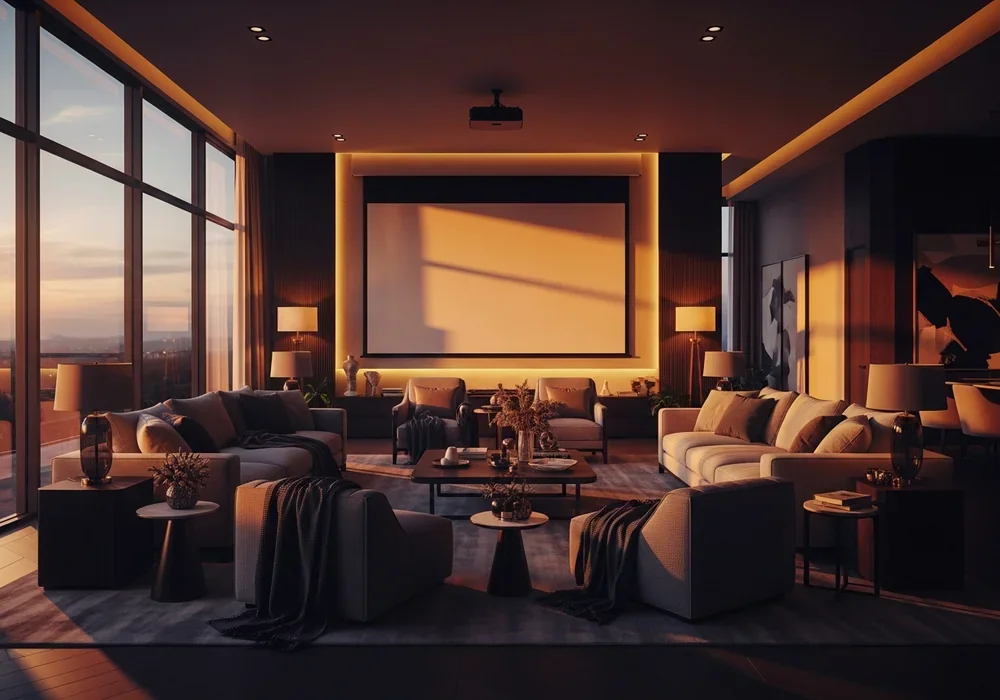
The Evolution of Living Spaces into Personal Sanctuaries
Imagine your living room after a long day. The sun sets, casting long shadows across your curated furniture. You want to escape into another world. In 2026, our homes are no longer just places to sleep. They have become our private theaters, our stadiums, and our sanctuaries. But how do you choose the right window into those worlds?
Many homeowners face a difficult crossroads. Should you opt for the classic reliability of a massive LED screen? Or is it time to embrace the cinematic glow of a high-end projector? This projector vs TV comparison isn’t just about specs. It is about how you feel when the lights go down. It is about the soul of your interior design.
This guide will walk you through every nuance. By the end, you will know exactly which device fits your walls. We will look at brightness, installation, and that elusive ‘cinema feel’. Your dream home theater starts with making the right choice today.
The Great Debate: Raw Immersion vs. Pixel Perfection
Size creates a physical reaction in our brains. Have you ever felt your heart race during an action sequence? That is the power of field-of-view. A projector easily hits 120 or 150 inches. To get that same size in a TV, you would need a small fortune. A 98-inch TV is impressive, but it feels like a piece of equipment. A 150-inch projection feels like an event.
When Size Is the Only Thing That Matters
Projectors offer a scale that TVs simply cannot match. Think about your favorite local cinema. The screen fills your entire vision. This immersion is why cinephiles love projectors. You aren’t just watching a movie; you are inside it. For sports fans, seeing players at nearly life-size changes the game entirely. It turns a simple Sunday into a stadium experience.
The Crisp Reality of Modern High-End TVs
However, TVs hold a significant edge in sheer clarity. A 4K OLED TV offers perfect blacks and infinite contrast. Every pixel emits its own light. This results in an image that looks like a vibrant window. If you prioritize seeing every single pore on an actor’s face, the TV wins. HDR (High Dynamic Range) also shines brighter on TVs. The highlights can be piercingly realistic, something most projectors struggle to replicate.
Daylight Dilemmas and the Magic of ANSI Lumens
Here is where many first-time buyers get confused. Have you heard of ANSI Lumens? It is the standard measure of a projector’s brightness. In a dark room, even a modest projector looks stunning. But add a little morning sunlight, and the image can vanish. This is a crucial factor in our projector vs TV comparison.
Why Sunlight Is the Projector’s Greatest Rival
Most household projectors offer between 2,000 and 3,500 ANSI Lumens. In a bright living room, this often isn’t enough. The colors wash out, and the blacks turn into a muddy gray. You have to invest in high-quality blackout curtains. For some, this ritual of ‘preparing the room’ is part of the charm. For others, it is a daily annoyance that prevents casual viewing.
OLED Dominance in Bright Living Room Interior That Will Transform Your Year”>Living Rooms
TVs are built to fight the sun. Modern screens can reach over 1,500 nits of brightness. They use anti-reflective coatings to minimize glare. You can watch the news at noon with the windows wide open. If your home features floor-to-ceiling glass and lots of natural light, a TV is the practical choice. It ensures you don’t have to live in a cave just to watch your favorite show.
A Deep Dive: Projector vs TV Comparison Breakdown
To make this easier, let’s look at the hard data. This table compares the two technologies across the most important categories for a modern home.
| Feature | Home Theater Projector (4K) | Large LED/OLED TV (85″+) |
|---|---|---|
| Maximum Size | 120″ – 150″+ (Very Flexible) | Fixed (Usually 65″ – 98″) |
| Daytime Visibility | Poor (Requires Dark Room) | Excellent (Very Bright) |
| Image Contrast | Good (Best in Pitch Black) | Superior (True Blacks) |
| Eye Comfort | High (Reflected Light) | Moderate (Direct Blue Light) |
| Installation | Complex (Mounting/Alignment) | Simple (Plug and Play) |
| Longevity | 20,000+ Hours (Laser) | 30,000 – 100,000 Hours |
As you can see, the choice isn’t about which is ‘better’. It is about which fits your specific environment. A projector is a specialist; a TV is a generalist.
The Minimalist’s Secret: Invisible Tech in Interior Design
At DesignHomes, we care about how tech impacts your style. A giant TV is a ‘black hole’ on the wall. When it is off, it is a massive, dark rectangle that consumes the room’s energy. It dictates where all the furniture must point. This can be a nightmare for minimalist or Japandi-style interiors.
Solving the ‘Black Hole’ Problem with Projectors
Projectors are the ultimate tool for a clean aesthetic. You can use a motorized screen that hides in the ceiling. Or, you can simply project onto a smooth, white-painted wall. When the movie is over, the ‘screen’ disappears. Your beautiful wallpaper or art gallery can take center stage again. It allows the room to serve multiple purposes without being dominated by a screen.
Short-Throw Wonders for Compact Urban Living
Are you worried about a small apartment? You might think a projector is impossible. Enter the Ultra Short Throw (UST) projector. These devices sit just inches away from the wall. They can create a 100-inch image from a console sitting right on your media cabinet. No long cables across the ceiling. No shadows when someone walks past. It is the perfect compromise for modern city living.
Installation Logistics: More Than Just Plugging It In
Installing a TV is straightforward. You mount it or set it on a stand. Done. A projector requires more thought. You have to consider the ‘throw distance’. This is the space between the lens and the wall. You also need to think about the screen material. While a white wall works, an ALR (Ambient Light Rejecting) screen makes a world of difference. It helps the projector perform even when some light is present.
Don’t forget the sound! Most projectors have weak internal speakers. You will need a dedicated soundbar or a 5.1 surround system. A high-end TV often has decent built-in audio, though we always recommend external speakers for a true cinema experience. Budgeting for sound is a vital part of your projector vs TV comparison journey.
The Final Verdict: Matching Technology to Your Lifestyle
So, which one should you choose? Honestly, it depends on your habits. If you are a hardcore gamer, a TV is likely better. TVs offer lower input lag and faster refresh rates for competitive play. They also handle the static HUD elements of games without any risk of burn-in (though modern projectors are getting better at this).
If you are a cinephile who saves movies for the evening, go for the projector. There is a softness to reflected light that is easier on the eyes. It feels more organic, like a real film print. Pair it with dimmable smart lighting and plush seating. You won’t just be watching a movie; you will be creating a memory every single night.
Whatever you choose, remember that the best technology is the one that brings people together. Whether it is a bright TV for family game night or a massive projector for a neighborhood movie marathon, make it yours. Your home is your canvas. Fill it with light.
Frequently Asked Questions
자주 묻는 질문
Does a projector require a lot of maintenance?
Modern laser projectors require very little maintenance and can last over 20,000 hours. Older lamp-based models need bulb replacements every few thousand hours, which can be costly.
Can I use a projector as a primary TV for daily news and shows?
You can, but it is less convenient. Projectors take a few seconds to warm up, and you will need to dim the lights every time you want to watch something during the day.
Is 4K really necessary for a projector?
Yes, especially at sizes over 100 inches. On such a large canvas, the extra detail of 4K is very noticeable compared to standard 1080p.
What is the best wall color for a projector if I don’t use a screen?
A flat, matte white is best for brightness. Some users prefer a light grey to improve contrast and black levels, but a dedicated screen will always provide the best results.

Kumar Tomar is a distinguished writer at DesignHomes.in, specializing in home design and interior decor. Holding a degree in Interior Design from the National Institute of Design, Kumar combines formal education with practical experience to deliver insightful and authoritative content. With over 8 years in the industry, he is known for his in-depth knowledge of design trends and his ability to provide actionable advice for homeowners. Kumar’s expertise and dedication to high-quality writing make him a trusted resource for those seeking to enhance their living spaces. Follow Kumar on Instagram for the latest design inspiration and tips.