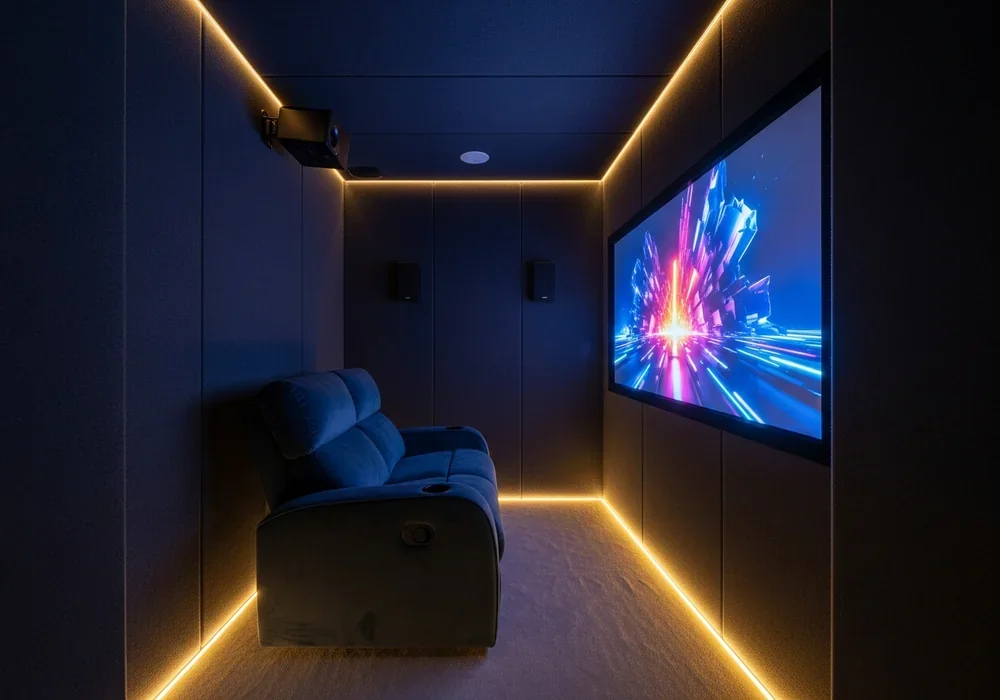
The Magic of the ‘Micro-Cinema’: Why Smaller is Often Better
Have you ever walked into a massive commercial theater and felt a bit… lost? There is an undeniable charm in intimacy. Transforming a compact area into a small room home theater isn’t just a compromise; it is an opportunity to create a bespoke, high-performance ‘micro-cinema’ that rivals any multiplex. In a smaller space, you have absolute control over every photon of light and every wave of sound. You aren’t just watching a movie; you are stepping inside it.
The secret to a successful small room home theater lies in the ‘Cozy Factor.’ While a large basement might feel cold and echoing, a 10×10 foot room naturally lends itself to a cocoon-like atmosphere. This inherent snugness, when paired with the right design principles, creates an unparalleled sense of immersion. By the time you finish this guide, you will know exactly how to turn that ‘storage room’ or ‘guest bedroom’ into the most popular destination in your home.
Mastering the Layout: The 3-Meter Rule for Maximum Immersion
Does your room feel too short for a big screen? Think again. The most common mistake beginners make is pushing the seating all the way against the back wall. While it seems like it saves space, it actually muddies the sound quality and makes the screen feel disconnected. Instead, try pulling your seating forward just 12 to 18 inches. This small gap allows for rear-channel speakers to breathe and prevents bass frequencies from building up in the corners.
When we talk about a small room home theater, the layout should prioritize the ‘Triangle of Sight.’ This involves aligning your primary seat, the screen center, and your speakers in a way that minimizes neck strain. If you are working with a 3-meter (approx. 10 feet) depth, you are in the ‘Goldilocks Zone’ for a 100-inch projection or an 85-inch TV. It’s about filling your field of vision without making your eyes dance from side to side.
Calculating the Sweet Spot: Screen Size vs. Viewing Distance
Let’s talk numbers because precision is what separates a hobbyist from a pro. For a truly cinematic experience, the Society of Motion Picture and Television Engineers (SMPTE) recommends a viewing angle of about 30 degrees. However, for a small room home theater, many enthusiasts prefer a 40-degree ‘immersive’ angle.
- 60-70 Inch Screens: Ideal for a viewing distance of 1.8 to 2.4 meters. Perfect for very tight ‘den’ style setups.
- 85-100 Inch Screens: The sweet spot for a 3-meter room. This provides that ‘front row’ feel without the eye fatigue.
- 120 Inches and Above: Generally risky for small rooms unless you use a 4K projector with high pixel density to avoid seeing individual pixels.
Projector vs. Large TV: Making the High-Stakes Choice
This is the age-old debate in the small room home theater community. Do you go with the raw brightness and sharpness of an OLED TV, or the sheer scale of a beam projector? The answer depends entirely on your light control. If your room has a window that you can’t perfectly block, a 75 or 85-inch Mini-LED TV will provide the punchy HDR (High Dynamic Range) you need.
However, if you can achieve ‘total blackout,’ nothing beats the aesthetic of a projector. Modern short-throw projectors can sit just inches from the wall and cast a 100-inch image, eliminating the need for complex ceiling mounts. But remember: projecting directly onto a white wall is a rookie move. Even a budget-friendly fixed-frame screen will increase your contrast ratio by 30-40% compared to a standard painted wall.
| Feature | Large OLED/LED TV | Short-Throw Projector |
|---|---|---|
| Image Size | Fixed (usually max 85-98″) | Flexible (80″ to 120″+) |
| Light Sensitivity | Works well in daylight | Requires dark room |
| Installation | Heavy, requires sturdy mount | Compact, sits on a console |
| Longevity | Consistent performance | Bulb or Laser lifespan varies |
| Immersion | High (Great contrast) | Extreme (Cinema-like feel) |
The Dark Arts: Mastering Light Control and Color Palettes
In a small room home theater, your walls are your worst enemy. Why? Because light from the screen bounces off white walls and reflects back onto the screen, washing out the blacks. To fix this, you don’t need to paint the whole room ‘Vantablack,’ but choosing a deep charcoal, navy, or forest green in a matte finish will drastically improve your perceived contrast.
The ‘Blackout Effect’ is non-negotiable. Blackout curtains are your best friend here. Don’t just settle for ‘room darkening’ fabrics; look for curtains with a dedicated thermal and light-blocking liner. For the best results, install the curtain rod 6 inches wider than the window on each side to prevent ‘light leakage’ from the edges. This doesn’t just help the picture; it also provides significant sound dampening for better room acoustics.
Sound Engineering for Tight Corners: Beyond the Soundbar
Sound behaves differently in small spaces. Bass waves are long, and in a tiny room, they tend to ‘trap’ in corners, leading to a boomy, muddy mess. This is where soundbar placement and acoustic treatment come into play. If you are using a soundbar, ensure it is at ear level when you are seated. If it’s tucked inside a cabinet, you are losing 50% of its clarity to internal reflections.
Acoustic Treatment: Turning a Boxy Room into a Sonic Haven
You don’t need a PhD in physics to improve your media room interior sound. Start with a thick, plush rug. Hardwood or tile floors reflect high-frequency sounds, making dialogue sound harsh. A rug acts as a natural absorber. Next, consider ‘First Reflection Point’ panels. These are acoustic foam or fabric panels placed on the side walls exactly where the sound from your speakers hits first. This simple addition sharpens the ‘stereo image,’ making it feel like the sound is coming from the screen, not just the boxes beside it.
The Unsung Heroes: Furniture and Cable Management
In a small room home theater, every square inch of floor space is premium real estate. Instead of a bulky 3-seater sofa, consider two high-quality recliners or a ‘loveseat’ configuration. Wall-hugging recliners are particularly effective because they can fully tilt back without needing 2 feet of clearance from the wall behind them.
Visual noise is just as distracting as actual noise. A nest of tangled HDMI and power cables will break the ‘cinematic spell’ instantly. Use cable molding (D-line trunking) that can be painted the same color as your walls to hide wires running to your projector. For devices like Apple TV or gaming consoles, use a ventilated media cabinet or ‘floating’ shelves to keep the floor clear and the look minimalist. Wireless kits for subwoofers are also a fantastic way to reduce clutter in a narrow room cinema.
Frequently Asked Questions
Is a 4K projector worth it for a small room?
Absolutely. Because you are sitting closer to the screen in a small room home theater, the increased pixel density of 4K is actually more noticeable than it would be in a large room. It prevents the ‘screen door effect’ where you can see the grid between pixels.
How do I prevent my home theater from disturbing the neighbors?
True soundproofing (decoupling walls) is expensive, but you can achieve 70% of the result with ‘mass-loaded vinyl’ or heavy rugs. Most importantly, use rubber isolation feet for your subwoofer to prevent vibrations from traveling through the floor joists.
Can I use a smart light bulb for cinema lighting?
Yes, and you should! Smart bulbs (like Philips Hue) allow you to set a ‘Movie Mode’ that dims the lights to 1% or changes them to a soft amber. Placing a light strip behind your TV (bias lighting) also reduces eye strain during long viewing sessions.
Bringing the Credits Up: Your Path to a Personal Cinema
Creating a small room home theater is a journey of balancing technology with interior design. It is about realizing that you don’t need a 500-square-foot basement to experience the thrill of the movies. By focusing on smart furniture placement, controlling your light environment, and being intentional with your audio setup, you can create a space that feels infinitely larger than its physical dimensions.
Remember, the best home theater is the one you actually use. Start with the basics: a great screen, a comfortable chair, and total darkness. Everything else—the fancy posters, the snack bar, the high-end speakers—can be added over time. Now, dim the lights, grab the popcorn, and enjoy the show in your very own, perfectly optimized small room home theater.
자주 묻는 질문
What is the ideal viewing distance for a 100-inch screen in a small room?
For a 100-inch screen, the sweet spot is typically between 2.5 to 3.5 meters (8 to 11 feet). This ensures a cinematic field of view while maintaining image clarity.
Can I use a white wall instead of a projector screen?
While you can, it’s not recommended. A dedicated screen has special coatings to reflect light back to the viewer and improve contrast. A standard wall absorbs light and shows texture, which degrades the 4K experience.
Are soundbars enough for a small room cinema?
In a small room, a high-quality Dolby Atmos soundbar can be very effective because the sound can bounce off the nearby walls to create a surround effect. However, for true immersion, a 5.1 system with dedicated rear speakers is always superior.

Kumar Tomar is a distinguished writer at DesignHomes.in, specializing in home design and interior decor. Holding a degree in Interior Design from the National Institute of Design, Kumar combines formal education with practical experience to deliver insightful and authoritative content. With over 8 years in the industry, he is known for his in-depth knowledge of design trends and his ability to provide actionable advice for homeowners. Kumar’s expertise and dedication to high-quality writing make him a trusted resource for those seeking to enhance their living spaces. Follow Kumar on Instagram for the latest design inspiration and tips.