The High-End Minimalist Revolution: Why Less is Finally More
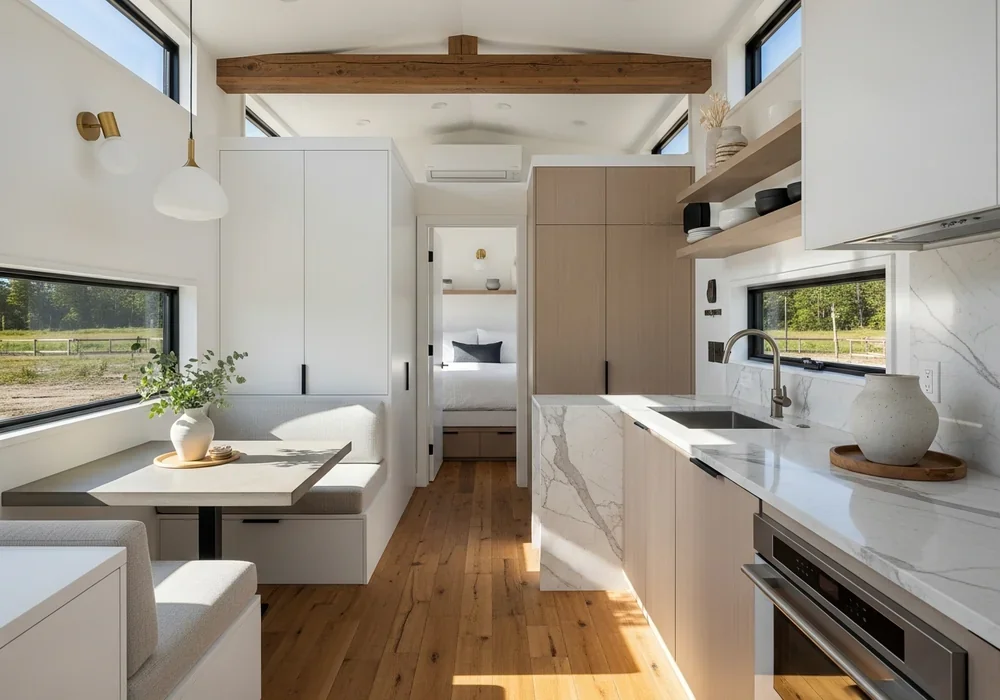
Imagine waking up in a room where every inch feels intentional. The morning sun spills across a reclaimed oak floor, hitting a wall that wasn’t there last night. You aren’t cramped; you’re curated. This is the heart of the 2026 tiny house trends. We’ve moved past the ‘pioneer’ phase of tiny living—those days of climbing awkward ladders to cramped lofts—and entered an era of high-end minimalism. It’s no longer about how much you can give up, but how much quality you can pack into a smaller footprint.
Have you ever felt like your house was wearing you, rather than you living in it? Large homes often demand our time, energy, and soul just for maintenance. In 2026, the trend has swung toward ‘liberation through limitation.’ By choosing a smaller space, homeowners are investing in premium materials—think Italian marble countertops and hand-finished cabinetry—that would be cost-prohibitive in a 3,000-square-foot mansion. This shift emphasizes the 2026 tiny house trends of sustainability and personal expression over mere volume.
Expert Tip: The 80/20 Material Rule
Invest 80% of your interior budget into the surfaces you touch every day—floors, handles, and countertops. In a tiny house, these tactile experiences define the sense of luxury more than the total square footage ever could.
The Shift from Survival to Sophistication
In the early 2020s, tiny houses were often seen as a desperate response to a housing crisis. Fast forward to 2026, and they have become a status symbol for the environmentally conscious and the digitally nomadic. The design language has matured. We see ‘soft minimalism’ replacing the cold, clinical looks of the past. Textures like boucle, brushed brass, and matte clay create a sensory-rich environment that prevents a small room from feeling like a box. The 2026 tiny house trends focus on the emotional resonance of the home, ensuring that ‘small’ feels ‘intimate’ rather than ‘restrictive.’
Furniture That Thinks: Beyond the Standard Murphy Bed
Remember when a ‘multi-purpose’ bed just meant a heavy wooden frame you had to wrestle into the wall? Those days are gone. The 2026 tiny house trends showcase furniture that responds to your schedule. We are seeing the rise of robotic furniture systems that slide, fold, and disappear at the touch of a button or a voice command. A home office by day seamlessly transitions into a dining room for six by evening, all thanks to motorized tracks hidden within the ceiling joists.
The integration of technology has reached a point where the furniture itself acts as a digital interface. Imagine a kitchen backsplash that doubles as a transparent OLED screen, displaying recipes or a calming forest view when not in use. This isn’t science fiction; it’s the standard for premium small-scale living in 2026. These ‘transformer’ pieces ensure that one room can serve four or five different functions without ever feeling cluttered or disorganized.
- Kinetic Walls: Internal partitions on silent magnetic tracks that allow you to expand the living room while shrinking the bedroom.
- Submerged Storage: Floor-integrated compartments that use the ‘dead space’ between chassis rails for seasonal items.
- Pneumatic Desks: Workstations that descend from the ceiling, keeping the floor plan completely clear when the workday ends.
AI-Driven Adaptability and Transparent OLED Integration
Artificial Intelligence now manages the ‘flow’ of the tiny home. Sensors detect your movement and adjust the lighting and temperature of specific zones. If you’re at your desk, the AI focuses heat there while dimming the rest of the house to save energy. This level of connectivity is a cornerstone of 2026 tiny house trends, making the home feel like a living, breathing assistant rather than just a structure. The use of transparent OLED glass in windows also allows for digital ‘curtains’ or augmented reality views, which is a game-changer for tiny houses parked in less-than-scenic urban environments.
Painting with Light: The ‘Layered White’ Secret for Infinite Depth
How do you make a 250-square-foot space feel like it has no boundaries? It’s all in the palette. While bold colors are trendy, the 2026 tiny house trends lean heavily into ‘Layered White’ and ‘Warm Neutrals.’ This isn’t just painting everything one shade of white. It’s about mixing textures—a matte white wall, a glossy white tile backsplash, and a cream wool rug. These layers catch the light differently, creating shadows and highlights that give the eye a sense of depth and distance.
Lighting in 2026 has moved away from the single ‘big light’ in the center of the ceiling. Instead, we use ‘perimeter washing’—hidden LED strips along the floor and ceiling edges that make the walls appear to push outward. Smart lighting systems now mimic the circadian rhythm, shifting from a crisp, blue-toned white in the morning to a warm, amber glow in the evening, ensuring the small space never feels oppressive regardless of the time of day.
Expert Tip: The Mirror Illusion
Place floor-to-ceiling mirrors opposite your largest window. In 2026, we use ‘tinted’ mirrors—bronze or smoke—to add depth without the jarring ‘funhouse’ effect of clear glass. It effectively doubles the visual horizon of your living area.
Maximizing Natural Luminescence through Architectural Glass
Windows are the most important ‘furniture’ in a tiny house. The current trend emphasizes oversized sliding glass doors that eliminate the barrier between the interior and the deck. When the door is open, your living room effectively doubles in size. Skylights, or ‘sky-tunnels,’ are also being used to bring light into the center of the home where side windows might not reach. This 2026 tiny house trend focuses on ‘borrowed views’—framing a tree or a patch of sky to make the interior feel like part of a much larger landscape.
Off-Grid Living Guide to Building a Smart Home Security Fortress Without Sacrificing Style”>Without Sacrificing an Ounce of Comfort
The dream of 2026 is ‘luxury off-grid.’ We’ve moved past the era of noisy generators and finicky composting toilets. Modern tiny houses are now built as ‘Passive Houses,’ meaning they are so well-insulated that they require almost no active heating or cooling. Combined with high-efficiency solar skins—where the solar cells are integrated directly into the roofing or siding materials—these homes can generate more power than they consume.
Water scarcity has also driven innovation. Closed-loop graywater systems now filter shower and sink water in real-time, making it safe for laundry or irrigation. This independence is a major driver of the 2026 tiny house trends, as it allows owners to park their homes in remote, beautiful locations without worrying about utility hookups. It’s the ultimate expression of modern freedom: a high-tech sanctuary that leaves no footprint.
| Feature | Traditional Tiny House (2016-2020) | 2026 Trend Tiny House |
|---|---|---|
| Energy Source | Propane / Grid Hookup | Integrated Solar Skin / AI Management |
| Space Management | Manual Lofts / Fixed Walls | Robotic Furniture / Kinetic Partitions |
| Water System | Fresh Tank / Black Tank | Closed-loop Graywater Recycling |
| Connectivity | Basic Wi-Fi | Full IoT / AI-driven Automation |
| Construction | Stick-built / Heavy | Modular Carbon-Fiber / Recycled Composites |
The Math of Modular: Comparing 2026 Construction Methods
If you’re looking to build in 2026, you’ll likely face a choice: custom-built on-site or factory-manufactured modular. The 2026 tiny house trends show a massive lean toward modular. Why? Because a factory environment allows for precision that’s impossible to achieve in the rain and wind of a construction site. Modular homes are built with aerospace-grade tolerances, ensuring that every ‘transformer’ piece of furniture fits perfectly without a millimeter of gap.
Cost-wise, modular units in 2026 are surprisingly competitive. While the initial price might seem high, the reduction in labor time and material waste makes them more affordable in the long run. We are seeing high-quality modular tiny homes starting at approximately $150,000 for a fully-equipped, luxury unit. This includes all the smart tech and high-end finishes that would cost double if installed piecemeal in a traditional build.
Factory Precision vs. On-Site Craftsmanship
While modular is king for efficiency, there is still a niche for ‘site-specific’ tiny houses. These are often built into difficult terrain, like cliffside perches or dense forest canopies. However, even these ‘bespoke’ builds are utilizing modular components—pre-fabricated bathroom ‘pods’ or kitchen ‘cores’ that are dropped into a custom frame. This hybrid approach is a key part of the 2026 tiny house trends, combining the soul of custom architecture with the reliability of industrial manufacturing.
Expert Tip: Budgeting for 2026
When planning your budget, set aside 15% for ‘Tech Integration.’ In 2026, a house that isn’t smart is a house that will have a lower resale value. Ensure your modular provider includes Cat-7 wiring or robust mesh-ready infrastructure.
Why Experiences Beat Square Footage Every Single Time
Ultimately, the surge in 2026 tiny house trends isn’t about the buildings themselves—it’s about the life they enable. When you spend less on heating a 2,000-square-foot house you barely use, you have more to spend on travel, fine dining, and hobbies. The tiny house movement has evolved into a ‘lifestyle-first’ philosophy. It’s about owning your time.
We are seeing a cultural shift where ‘wealth’ is measured by the quality of your morning coffee and the view from your window, not the number of empty guest rooms in your hallway. The 2026 tiny house is a tool for living, designed to be as efficient and beautiful as a high-end watch. It’s small, yes, but it’s also perfect. And in a world that’s increasingly noisy and cluttered, having a perfect, quiet, and sustainable space of your own is the truest luxury of all.
As we look forward, the 2026 tiny house trends will continue to push the boundaries of what ‘home’ means. Whether it’s a modular unit in the city or an off-grid pod in the mountains, the focus remains the same: maximizing the human experience through thoughtful, intentional design. Are you ready to downsize your space and upsize your life?
Summary: The Future of Small Living
- Smart Adaptability: Furniture and walls that move to suit your daily routine.
- Eco-Independence: High-efficiency passive designs with integrated solar and water recycling.
- Quality Over Quantity: Using premium materials in a small footprint to create a sense of ‘High-End Minimalism.’
If you’re feeling inspired to start your own tiny journey, the best first step is to audit your current living habits. What do you actually use? What brings you joy? The 2026 tiny house trends are here to help you build a life that fits you perfectly.
자주 묻는 질문
How much does a high-end tiny house cost in 2026?
In 2026, a fully-featured, luxury modular tiny house typically ranges from $120,000 to $200,000. This includes advanced IoT integration, sustainable energy systems, and premium interior finishes.
Is it possible to live completely off-grid in a tiny house?
Yes. With 2026 technology like integrated solar skins, atmospheric water generators, and closed-loop graywater systems, tiny houses can operate entirely independently from city utilities.
What is ‘Layered White’ in interior design?
It’s a technique using various shades and textures of white and cream to create depth and interest in a small space, preventing it from looking flat or cramped.
Do tiny houses hold their resale value?
High-end tiny houses built with modular precision and smart technology tend to hold their value well, especially as the demand for sustainable and flexible living options continues to rise.

Kumar Tomar is a distinguished writer at DesignHomes.in, specializing in home design and interior decor. Holding a degree in Interior Design from the National Institute of Design, Kumar combines formal education with practical experience to deliver insightful and authoritative content. With over 8 years in the industry, he is known for his in-depth knowledge of design trends and his ability to provide actionable advice for homeowners. Kumar’s expertise and dedication to high-quality writing make him a trusted resource for those seeking to enhance their living spaces. Follow Kumar on Instagram for the latest design inspiration and tips.